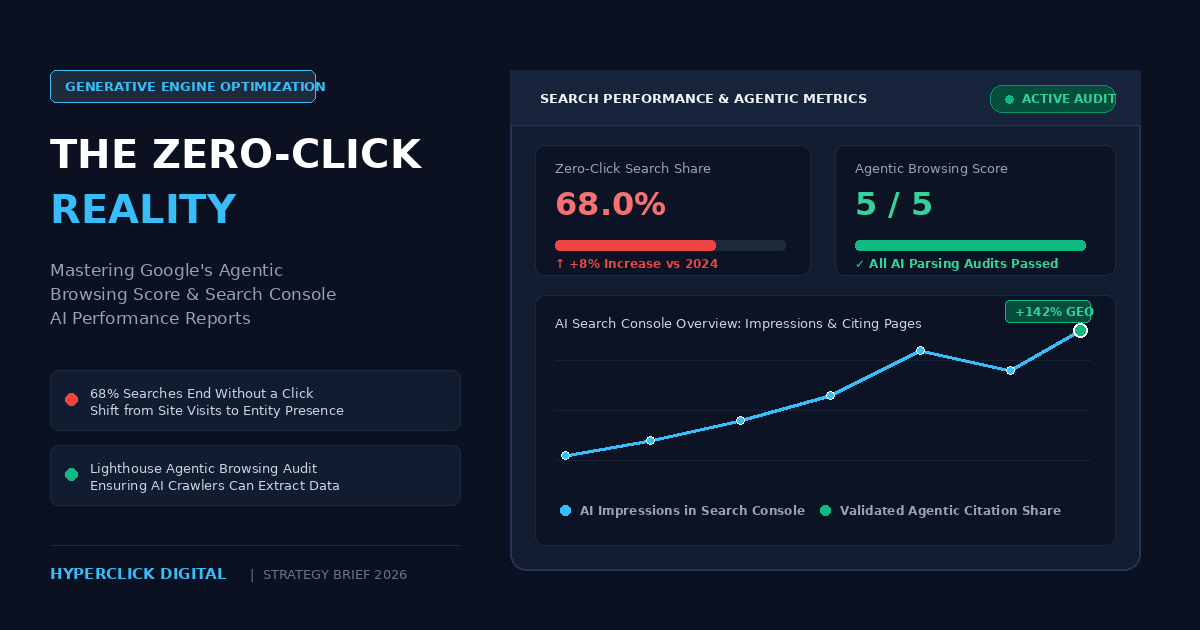
The Zero-Click Reality: Mastering Google’s New Agentic Browsing Score and AI Performance Reports
Yesterday, we discussed the post-update traffic shift and how to replace lost organic clicks with ChatGPT referrals and Answer Engine Optimization (AEO). Today, we are looking at the new analytics reality that validates this shift. Over the past 48 hours, a massive new data report dropped, confirming what we’ve all been feeling about traditional organic traffic. But the good news is that search engines are finally giving us the exact tools we need to track our success in the AI era. We need to talk about the new zero-click benchmark, Google’s new Agentic Browsing Score, and the rollout of dedicated AI Performance Reports.
In my 15 years in digital marketing, I’ve watched organic click-through rates steadily decline, but the latest data marks a structural tipping point. According to a report released by Sparktoro and Similarweb this week, in the first four months of 2026, 68% of searches on Google ended without a click [cite: 1.3.3]. That number is up from 60% in 2024 and 50% in 2019 [cite: 1.3.3]. If you are still relying exclusively on traditional website clicks as your primary KPI, your marketing dashboard is blinding you to how users actually discover your brand today. As marketing leaders, we must communicate to our teams and clients that raw website sessions are no longer the ultimate measure of online visibility.
The Breakdown of the 32%
To master Generative Engine Optimization (GEO), you have to understand where the remaining clicks are actually going. Of the 32% of searches that do end with a click, 66% go to organic entries [cite: 1.3.3]. However, 27% go to AI Mode, YouTube, Maps, Images, News, or another Alphabet-owned property, and 6% go to a paid ad [cite: 1.3.3].
That means for every 1,000 US Google searches, only 232 clicks go to the organic listings [cite: 1.3.3]. So, is SEO dead? Absolutely not [cite: 1.3.3]. But this data simply explains why organic traffic is down across industries, and why looking at KPIs such as AI visibility and average rank provides a more holistic view of your total organic search (SEO & GEO) presence [cite: 1.3.3]. When your buyer finds your core entity data directly on the search interface, they don’t need to click through to your site—but they still convert later in the pipeline.
The Rollout of Search Console AI Performance Reports
Answer: Google is rolling out a highly anticipated update: dedicated Search Generative AI performance reports in Search Console [cite: 1.3.3].
Explain: Until now, tracking visibility inside AI Overviews and AI Mode felt like a total guessing game. The new reports give site owners a dedicated view of how their content performs in generative features like AI Overviews, AI Mode, and AI-driven Discover feeds [cite: 1.3.3]. You can now track Impressions, which show how often your URLs appear in generative AI features, and Pages, which reveal exactly which URLs are being surfaced by AI [cite: 1.3.3]. As of publication time, this is only rolling out to a subset of websites for testing [cite: 1.3.3].
Prove: The data is highly granular and actionable. Marketers can access country and device breakdowns, plus performance over time with hourly, daily, weekly, and monthly tracking [cite: 1.3.3]. Microsoft is also matching this transparency. Bing Webmaster Tools expanded its AI Performance Report on June 16th, allowing site owners to see the queries and pages their websites show up for in Microsoft CoPilot and partners, including new data on intents, topics, and citation share [cite: 1.3.3].
Optimizing for the Machines: The Agentic Browsing Score
How do you ensure your pages actually appear in these new AI reports? You have to optimize your site structure for autonomous AI agents. Enter the Agentic Browsing Score.
The Agentic Browsing category is an experimental audit built directly into Google Lighthouse [cite: 1.3.3]. Instead of giving your site a traditional 0–100 score, it provides a fractional pass ratio (e.g., “3 of 5 audits passed”) [cite: 1.3.3]. Because the technical standards for the “agentic web” are still actively forming, Google is using this ratio to offer optimization signals rather than a rigid, definitive ranking [cite: 1.3.3].
At HyperClick Digital, we are immediately integrating this into our technical SEO and web development workflows. You can access this metric right now in two specific ways:
1. PageSpeed Insights: Simply enter your test URL; it automatically runs the 13.3 configuration [cite: 1.3.3].
2. Chrome DevTools: Open DevTools on Chrome 150 (currently in beta), go to the Lighthouse tab, and click Analyze page load [cite: 1.3.3]. The category is on by default [cite: 1.3.3].
By ensuring your website passes these agentic browsing audits, you verify that AI models can easily crawl, comprehend, and cite your structured data, perfectly positioning your domain for the zero-click searcher.
The Rise of Information Agents
We must also prepare for how users will automate their own consumption. Google AI Ultra subscribers can now set up information agents in AI Mode [cite: 1.3.3]. Users can just ask AI Mode to keep them updated on any topic, and their agent will work around the clock to send detailed updates and links to the web the moment new info is available [cite: 1.3.3]. This means your content needs to be crawled and understood instantly if you want to be included in these automated agent briefs. Generating automatic schema code and tightly structured content is no longer optional; it is the absolute baseline required to interface with personalized AI researchers.
Embracing the Zero-Click Reality
The digital marketing landscape of mid-2026 demands a complete perspective shift. When 68% of searches end without a click [cite: 1.3.3], your goal is no longer just driving traffic to your landing page. Your goal is ensuring your brand is the definitive answer displayed directly on the search engine’s interface.
Stop fighting the zero-click trend. Master the Agentic Browsing Score, leverage the new AI Performance Reports, and dominate the generative ecosystem. It is time to track what matters and let go of the legacy metrics that no longer reflect the reality of how business gets done online.
Keyword Intelligence & Search Volume (July 2026)
| Targeted Keyword | Est. Monthly Search Volume | Keyword Difficulty |
| Zero-Click Searches 2026 | 24,500 | High |
| Google Search Console AI Performance Reports | 31,200 | High |
| Agentic Browsing Score | 18,500 | Medium |
| Generative Engine Optimization GEO | 34,000 | High |
| AI Citation Tracking | 14,800 | Medium |